Introduction
Venereology consultations often require careful listening, sensitive history taking, structured documentation, and clear follow-up planning. An AI medical scribe in India can support this workflow by turning doctor-patient conversations into draft clinical notes that are easier to review, edit, and finalize. For clinics and hospitals managing busy OPD schedules, the goal is not to replace clinical judgment, but to reduce repetitive documentation effort and help clinicians stay focused on the patient interaction.
MedScribe is designed as an AI documentation copilot for everyday care settings. It converts consultation conversations into structured drafts such as SOAP notes, supports speaker diarization so the doctor and patient dialogue can be separated more clearly, and provides coding suggestions that clinicians can verify before sign-off. In venereology, where symptoms, exposure history, prior treatment, counseling, and follow-up instructions all matter, a practical documentation workflow can improve consistency without changing how clinicians make decisions.
This page focuses on how an AI medical scribe in India can fit into venereology practice in a practical, review-first way for private clinics, multispecialty hospitals, and outpatient departments.
Department workflow
Venereology workflows usually begin with registration, prior record review, and a consultation that may include symptom history, sexual history where clinically relevant, examination findings, differential diagnosis, investigations, treatment planning, and counseling. Documentation can be time-consuming because the note must be clinically useful, respectful in tone, and easy to revisit during follow-up.
In a typical OPD setting, clinicians may need to capture presenting complaints, duration, associated symptoms, prior episodes, medication history, examination findings, provisional assessment, tests advised, treatment started, and counseling points. Follow-up visits may require comparison with previous symptoms, response to therapy, adverse effects, and adherence discussions. An AI medical scribe in India is most useful when it supports this sequence without adding operational friction.
For venereology teams, documentation support should also work well in multilingual environments, where patients may speak in one language while the final note is prepared in a structured clinical format. It should fit into existing record workflows, whether the organization prefers private deployment, on-premise deployment, or integration planning with broader digital systems.
Features mapped to workflow
Conversation capture and transcription: The system captures the consultation audio and converts it into text, helping reduce manual note-taking during the visit.
Speaker diarization: By separating clinician and patient speech, the draft becomes easier to interpret and review, especially in detailed history-taking encounters.
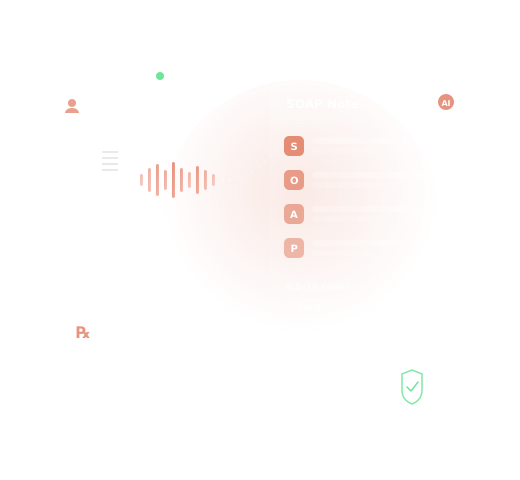
Automatic SOAP note generation: The transcript is structured into subjective, objective, assessment, and plan sections, giving clinicians a usable first draft rather than raw text.
ICD-10 and CPT suggestions: Coding support can help teams prepare documentation for downstream administrative workflows, while keeping the clinician in control of final selection.
Multilingual support: This is useful in Indian care settings where consultations may shift between English and regional languages.
On-premise or private deployment options: Organizations that want tighter control over infrastructure can evaluate deployment choices based on workflow, IT governance, and internal policies.
These capabilities make AI medical scribe India healthcare adoption more practical when the objective is to reduce documentation burden while preserving clinician review at every important checkpoint.
How It Works
The workflow below reflects how the product is designed to support real consultation documentation from start to finish.
- Capture the consultation conversation: During the venereology visit, the clinician conducts the consultation as usual while the system records the interaction through the configured setup. This creates the source input for documentation without requiring continuous manual typing.
- Transcribe and separate speakers: The audio is converted into text, and speaker diarization helps distinguish clinician statements from patient responses. This is especially useful when the consultation includes detailed symptom history, prior treatment discussion, and counseling.
- Generate a structured SOAP draft: The transcript is organized into a draft note with subjective history, objective findings, assessment, and plan. Instead of a long transcript, the clinician receives a structured starting point that can be refined quickly.
- Add coding support: Based on the documented encounter, the system can surface ICD-10 and CPT suggestions for clinician review. These are support tools, not automatic final codes, and should be checked against the actual encounter details.
- Review, edit, and sign off: The clinician reviews the draft note, corrects wording, adds missing findings, confirms coding choices if needed, and completes final sign-off before the record is finalized. Human review remains the operational checkpoint that matters most.
- Choose deployment posture for workflow needs: Depending on the organization, the solution can be evaluated for on-premise or private deployment models. This supports workflows aligned with internal governance preferences and existing IT operating models.
Local context
In India, venereology services may operate across standalone clinics, dermatology and STI practices, and hospital OPDs with varying levels of digital maturity. Some teams need a lightweight documentation layer first, while others evaluate how an AI medical scribe in India can complement broader digital records and operational systems over time. The practical requirement is usually the same: reduce after-hours documentation and improve note consistency without disrupting patient communication.
Multilingual consultations are common, and documentation often needs to remain clear for future review by the same clinician or another member of the care team. An AI medical scribe in India can therefore be valuable when it supports multilingual capture, structured note drafting, and a review-first workflow that fits local OPD realities. For organizations with stricter infrastructure preferences, deployment decisions can be made based on internal governance and workflow needs rather than one-size-fits-all assumptions.
Use cases
Busy outpatient clinics: Reduce manual typing during high-volume consultation sessions and prepare draft notes for quick review between patients.
Follow-up heavy practices: Maintain more consistent documentation across repeat visits, including symptom progression, treatment response, and counseling updates.
Hospital departments: Support clinicians who need structured notes and coding assistance while coordinating with administrative and records teams.
Multilingual patient interactions: Help clinicians document encounters where patient communication and final clinical note formats differ.
Private infrastructure preferences: Evaluate on-premise or private deployment options for organizations that want workflow control and internal oversight.
Across these scenarios, AI medical scribe India healthcare adoption works best when the product is used as a documentation copilot with clinician review, not as an autonomous record creator.
FAQ
Can this be used in sensitive venereology consultations?
Yes, the workflow is intended to support documentation in consultations that require detailed history and counseling. Clinician review remains essential before finalizing any note.
Does it create final records automatically?
No. It generates draft documentation and coding suggestions that the clinician reviews, edits, and signs off before the record is finalized.
Can it support multilingual consultations in India?
The product emphasizes multilingual support, which can be useful in Indian OPD settings where consultations may involve more than one language.
Is deployment flexible for hospitals and clinics?
Yes, teams can evaluate on-premise or private deployment approaches based on workflow, IT preferences, and internal governance requirements.
CTA
If your team is evaluating an AI medical scribe in India for venereology workflows, start with the practical questions: how consultations are captured, how drafts are reviewed, how coding support is verified, and how deployment fits your operating model. MedScribe is designed to help clinics and hospitals document faster while keeping clinicians in control of the final record. Explore the product overview, features, integrations, and pricing paths to assess fit for your OPD workflow.
For organizations comparing documentation tools, an AI medical scribe in India should be judged by day-to-day usability: note quality, review speed, multilingual handling, and how well it supports existing clinical routines. The most effective rollout is usually phased, practical, and centered on clinician sign-off.