Introduction
Wound care nursing teams manage detailed, repetitive documentation across assessments, dressing changes, pain updates, infection observations, follow-up plans, and coordination with physicians. An AI medical scribe in India can help reduce manual note-taking by turning consultation and care conversations into structured clinical documentation that is easier to review and finalize. For hospitals, clinics, and specialty wound care units, the goal is practical: save time on routine charting, improve note consistency, and support smoother handoffs without changing the clinician’s judgment.
MedScribe is designed as an AI documentation copilot for day-to-day OPD and inpatient workflows. It converts spoken interactions into draft SOAP notes, supports speaker diarization, and provides coding suggestions that clinicians can review before final sign-off. For wound care nursing, this means less time rewriting routine observations and more time focused on patient education, dressing technique, escalation, and continuity of care.
This page focuses on how an AI medical scribe in India fits wound care nursing workflows in a practical healthcare setting. The emphasis is on usable documentation support, human review, and deployment choices that support workflows aligned with local governance needs.
Department workflow
Wound care documentation often spans multiple touchpoints rather than a single short encounter. A nurse may begin with intake details, review wound history, capture comorbid factors such as diabetes or immobility, document wound location and appearance, note exudate, odour, pain, peri-wound skin condition, dressing material used, and patient response. In many settings, the same patient may return for serial assessments, making consistency across notes especially important.
Typical workflow steps include patient intake, wound assessment, discussion with the patient or caregiver, treatment or dressing change, escalation to a physician when needed, discharge or follow-up instructions, and record completion. Documentation can become fragmented when parts of the encounter are written later from memory. An AI medical scribe in India can support this workflow by capturing the conversation in real time, organizing it into a structured draft, and helping the clinician complete the record with fewer manual steps.
For wound care nursing teams, the value is not only speed. It is also about clearer chronology, more consistent note structure, and easier review of what was observed, what was done, and what follow-up was advised. This is useful in both standalone clinics and larger hospitals where multiple caregivers contribute to the patient record.
Features mapped to workflow
Automatic SOAP note generation: Converts encounter conversations into draft subjective, objective, assessment, and plan sections. In wound care, this helps organize symptom updates, wound findings, treatment performed, and next-step instructions into a familiar format.
Speaker diarization: Distinguishes between clinician and patient voices, which is useful when documenting patient-reported pain, caregiver concerns, and nurse observations separately.
Multilingual support: Many Indian care settings involve mixed-language conversations. Multilingual capture can help teams document encounters where English clinical terminology is used alongside Hindi or regional language discussion.
ICD-10 and CPT suggestions: Coding support can help surface likely documentation-linked codes for clinician review. It is not a replacement for coding judgment, but it can reduce repetitive lookup work.
On-premise or private deployment options: Some hospitals prefer tighter infrastructure control for documentation workflows. Deployment posture can be chosen as an operational and governance decision based on internal requirements.
Review before finalization: Drafts are meant to be checked, edited, and approved by the clinician. This is especially important in wound care where small wording differences can affect continuity, escalation, and follow-up planning.
How It Works
The workflow is designed to support the full path from conversation capture to clinician-approved documentation.
- Capture the encounter conversation: During a wound care consultation, dressing change, or follow-up review, the system captures the spoken interaction between nurse, patient, caregiver, and where relevant, the physician. Speaker diarization helps separate who said what, which is useful for documenting symptoms, observations, and instructions accurately.
- Transcribe and structure the discussion: The audio is converted into text and organized into clinically relevant sections. Instead of leaving the team with a raw transcript, the system prepares structured content that reflects the flow of assessment, intervention, and plan.
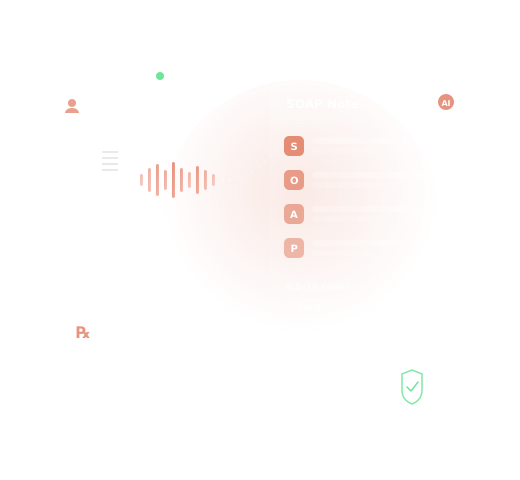
- Draft a SOAP note automatically: Based on the structured transcript, MedScribe generates a draft SOAP note. For wound care nursing, this may include patient-reported pain or discharge concerns in the subjective section, wound appearance and dressing details in the objective section, clinical impression in the assessment section, and dressing advice, escalation, or follow-up in the plan.
- Surface coding suggestions for review: The platform can provide ICD-10 and CPT suggestions linked to the documented encounter. These suggestions are intended to support clinician or coding team review, not replace final coding decisions.
- Clinician edits, verifies, and signs off: A nurse or supervising clinician reviews the draft, corrects terminology, adds missing wound-specific details, and confirms the final note before it becomes part of the record. Human review is an operational checkpoint built into the workflow.
- Choose deployment posture to fit operations: Depending on the organization’s needs, teams may use on-premise or private deployment approaches. This supports documentation workflows aligned with internal IT and governance preferences rather than offering blanket compliance claims.
Local context
In India, wound care services often operate across busy outpatient departments, multispecialty hospitals, diabetic foot clinics, post-surgical follow-up units, and home-linked care programs. Documentation needs can vary by setting, but common challenges remain the same: high patient volume, mixed-language communication, repeated follow-ups, and the need for clear notes that support continuity across teams.
An AI medical scribe in India is most useful when it adapts to these practical realities. Multilingual support matters when patient education happens in one language and the final note is reviewed in another. Structured note generation matters when clinicians need consistency across serial visits. Review workflows matter because wound care often depends on nuanced observations that require clinician confirmation.
For healthcare organizations evaluating an AI medical scribe in India, the key question is not whether AI can replace documentation judgment. It is whether the tool can reduce repetitive typing, support better note structure, and fit existing care delivery patterns without adding friction.
Use cases
Diabetic foot follow-up: Capture symptom changes, wound progression, dressing details, offloading advice, and referral notes in a structured draft.
Post-operative wound review: Document healing status, pain, discharge, redness, dressing changes, and surgeon escalation points more consistently.
Pressure injury management: Support recurring documentation across inpatient or long-term care settings where serial assessments are common.
Burn and trauma aftercare: Help teams record wound observations, patient discomfort, dressing technique, and home-care instructions with less manual repetition.
Multidisciplinary coordination: Improve handoff quality when nurses, physicians, and allied staff need a clearer summary of what was observed and advised.
Across these scenarios, an AI medical scribe in India can support documentation quality by creating a usable first draft while keeping the clinician in control of the final record.
FAQ
Can this be used for wound care nursing notes specifically?
Yes. The workflow is well suited to wound care encounters that involve assessment, treatment discussion, dressing details, patient education, and follow-up planning.
Does it replace clinician documentation review?
No. The draft should be reviewed, edited where needed, and approved by the clinician before finalization.
Can it handle multilingual consultations?
It is designed with multilingual support, which can help in Indian healthcare settings where patient conversations and clinical terminology may be mixed across languages.
Does it provide coding support?
Yes. It can surface ICD-10 and CPT suggestions to support review, but final coding decisions should remain with the appropriate clinical or coding team.
Is deployment flexible for hospitals?
Yes. On-premise and private deployment options can support organizations that want documentation workflows aligned with internal IT and governance preferences.
CTA
If your wound care team is spending too much time on repetitive charting, MedScribe can help streamline note creation while keeping review and sign-off with the clinician. Explore whether an AI medical scribe India healthcare workflow fits your OPD, specialty clinic, or hospital documentation process. Start with the core product pages for MedScribe, review detailed capabilities on features, and assess how an AI medical scribe in India can support practical wound care documentation at scale.