Introduction
Healthcare teams need digital systems that fit daily care delivery, not just billing or basic record storage. EMR software in Hyderabad can help clinics and hospitals move from fragmented notes and disconnected files to structured patient records, clearer documentation, and more consistent OPD and IPD workflows. For organisations managing growing patient volumes, multiple doctors, and varied specialties, the value of an EMR lies in making registration, consultation, charting, follow-up, and reporting easier to manage in one place.
This EMR platform is designed for hospital and clinic operations with structured records, implementation playbooks, and documentation workflows aligned with practical care delivery. It supports multilingual documentation, AI-assisted notes, OPD management, and readiness for interoperability-oriented workflows such as ABHA-linked processes where relevant. It is also designed to align with broader digital health directions in India, including ABDM, while keeping policy references practical and limited to workflow relevance.
For providers evaluating EMR software in Hyderabad, the key question is not only whether the system stores records, but whether it helps teams document consistently, retrieve history quickly, and coordinate across front desk, doctors, nursing, and administration without adding unnecessary complexity.
Department workflow
Although EMR adoption often starts with one service line or one location, the core workflow is similar across many outpatient and inpatient settings. A patient journey usually begins with registration and demographic capture, followed by appointment or walk-in intake, consultation, clinical documentation, orders or care instructions, and then discharge, follow-up, or revisit planning. In hospitals, this extends into admission workflows, progress notes, care coordination, and discharge summaries. In clinics, the focus is often on faster chart access, repeat visit continuity, and standardised consultation notes.
An effective EMR supports these stages with structured fields instead of scattered free text alone. That means teams can capture complaints, history, vitals, assessments, medications, and follow-up advice in a repeatable format. For Hyderabad-based providers serving diverse patient populations, multilingual documentation support can also improve usability for clinicians and staff. The result is a workflow that is easier to train, easier to review, and more useful for continuity of care.
Features mapped to workflow
Registration and intake: Structured patient profiles help front-desk teams capture demographics, identifiers, visit context, and contact details in a consistent way. This reduces duplicate records and improves revisit handling.
Consultation and charting: Doctors can document encounters using structured templates, specialty-relevant note formats, and AI-assisted note support where appropriate. This helps standardise records while preserving clinical flexibility.
OPD and IPD operations: The platform supports workflows aligned with outpatient consultations as well as inpatient documentation needs, including progress tracking and discharge-related records.
Clinical history retrieval: Longitudinal patient records make it easier to review prior visits, diagnoses, medications, and care plans before or during consultation.
Role-based access: Different users can work within permissions suited to their responsibilities, helping organisations manage access to sensitive information in a practical way.
Reporting and review: Structured data entry improves internal reporting, operational review, and documentation quality checks without relying entirely on manual compilation.
These capabilities are especially relevant when selecting EMR software in Hyderabad for multi-doctor clinics, day-care centres, and hospitals that want a system built around care workflows rather than isolated data entry screens.
How It Works
The rollout approach for this EMR is phased so teams can move from setup to adoption with less disruption. The process is designed around real clinical operations rather than a one-time software handover.
- Set up intake and registration workflows: Start by configuring patient registration fields, visit types, identifiers, and front-desk intake steps. This creates a structured base for OPD appointments, walk-ins, and hospital admissions so records begin consistently from the first touchpoint.
- Build documentation templates for consultations and charting: Configure consultation notes, history formats, vitals capture, assessment sections, medication documentation, and discharge or follow-up templates. Structured templates help doctors and care teams record information in a repeatable format while supporting specialty-specific needs.
- Enable team adoption by role: Train front-desk staff, doctors, nursing teams, and administrators on their part of the workflow. Role-based access helps each user see the functions relevant to registration, consultation, chart review, discharge preparation, and reporting, while supporting record controls aligned with organisational policies.
- Run live workflows across OPD and IPD operations: Once configured, teams use the EMR for patient intake, consultation documentation, clinical history review, progress notes, discharge summaries, and follow-up planning. AI-assisted notes and multilingual documentation can support faster charting where appropriate.
- Audit usage and optimise documentation quality: Review how templates are being used, where records are incomplete, and which steps slow down care delivery. Structured reporting and implementation playbooks help refine workflows over time so the system better supports day-to-day operations and policy-aware documentation practices.
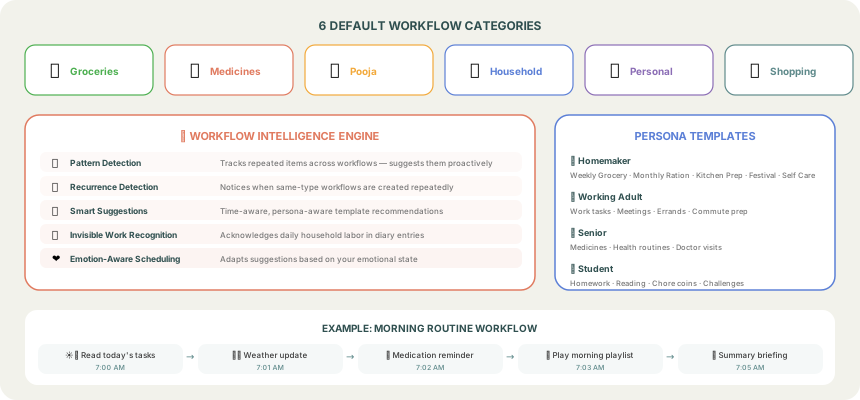
This practical rollout model is useful for organisations comparing EMR software in Hyderabad because implementation quality often determines whether the system improves documentation or simply adds another layer of work.
Local context
Hyderabad has a broad mix of independent clinics, specialty centres, and growing hospital groups. Many providers need systems that can support both high-volume OPD care and more detailed inpatient or procedural documentation. In this environment, an EMR should be flexible enough for single-location practices while also supporting standardisation across larger teams.
For providers considering EMR software in Hyderabad, local relevance often means practical concerns: faster revisit handling, better chart availability across shifts, cleaner discharge documentation, and easier internal coordination. It can also mean preparing for digital health workflows that are increasingly important in India. Where needed, the platform supports workflows designed to align with ABDM-oriented interoperability expectations and documentation practices informed by health data governance principles, without overcomplicating routine care delivery.
The goal is not to force a generic template onto every organisation, but to provide a structured system that can adapt to how clinics and hospitals in Hyderabad actually work.
Use cases
Multi-doctor clinics: Standardise consultation notes, improve revisit continuity, and reduce dependency on handwritten or fragmented records.
Specialty practices: Use structured templates for repeatable documentation while preserving specialty-specific clinical detail.
Hospitals: Support OPD and IPD workflows with clearer patient histories, progress documentation, and discharge-related records.
Growing healthcare groups: Create more consistent documentation practices across locations and teams using implementation playbooks and structured workflows.
Practices moving from paper or basic software: Shift toward searchable records, role-based access, and more organised reporting without redesigning every process at once.
These scenarios reflect why many providers search for EMR software in Hyderabad and related terms such as EMR software Hyderabad healthcare when they want a system that supports both clinical usability and operational consistency.
FAQ
Is this EMR suitable for both clinics and hospitals?
Yes. The platform is designed for clinic and hospital workflows, including structured records, OPD processes, and documentation needs that can extend into IPD operations.
Can doctors use templates without losing flexibility in notes?
Yes. Structured templates help standardise documentation, while clinicians can still capture case-specific details needed for safe and useful records.
Does the system support multilingual documentation?
Yes. Multilingual documentation support can help teams work more comfortably across varied patient and clinician communication needs.
How does the EMR help with policy-aware record handling?
It includes role-based access and documentation controls designed to support workflows aligned with organisational privacy and governance practices. It is best understood as a tool that supports policy-aligned operations rather than a guarantee of compliance.
CTA
If your organisation is evaluating EMR software in Hyderabad, focus on how the system will perform during real registration, consultation, charting, discharge, and follow-up workflows. A practical EMR should help teams document consistently, retrieve records quickly, and adopt digital processes in phases. Explore the product, review feature details, and assess whether the workflow design fits your clinic or hospital operations in Hyderabad.