Introduction
EMR software in Faridabad helps clinics and hospitals move from fragmented paper files and scattered digital notes to a more structured, searchable, and workflow-friendly record system. For healthcare teams managing OPD consultations, repeat visits, admissions, discharge summaries, and follow-up communication, an EMR should do more than store data. It should support day-to-day clinical work with clear documentation, faster retrieval of patient history, and better coordination across front desk, doctors, nursing teams, and administration.
This EMR platform is designed for Indian healthcare settings with structured patient records, OPD and IPD workflow support, multilingual documentation options, AI-assisted note creation, and implementation playbooks that help teams adopt the system in phases. It is also designed to align with interoperability-focused initiatives such as ABDM, where relevant, and supports workflows aligned with privacy-conscious record handling principles referenced in national digital health guidance. For providers evaluating EMR software in Faridabad, the practical goal is simple: reduce documentation friction while improving continuity of care.
Department workflow
Although this page is not limited to one specialty, the workflow needs are familiar across multispecialty clinics, day-care centres, and hospitals in Faridabad. A patient journey often starts at registration, moves into consultation, then branches into prescriptions, investigations, procedures, admission, discharge, and follow-up. Without a structured EMR, each handoff can create delays, duplicate entry, or missing context.
An effective EMR supports front-desk registration with demographic capture, visit creation, and patient search. During consultation, clinicians need quick access to prior complaints, diagnoses, medications, allergies, and treatment plans. For admitted patients, teams need progress notes, order visibility, discharge documentation, and a reliable longitudinal chart. Administrative users also need reporting views that help monitor documentation completeness and operational trends without disrupting clinical work.
For organisations comparing EMR software Faridabad healthcare options, the key is whether the system maps to real care delivery steps rather than acting as a generic database. Structured records, role-based access, and configurable templates make the workflow more usable for both small practices and growing hospitals.
Features mapped to workflow
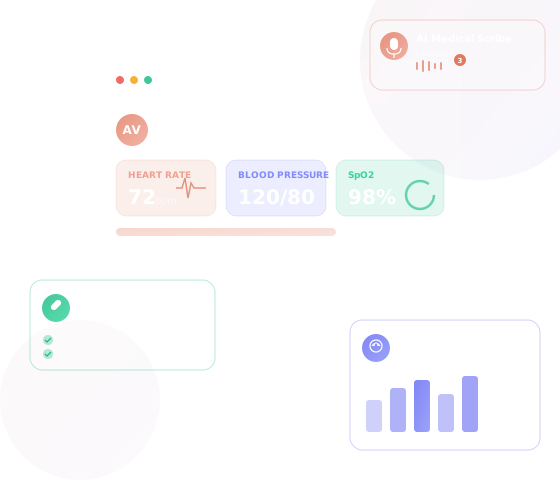
Structured patient records: A unified chart helps clinicians review demographics, visit history, diagnoses, medications, allergies, and clinical notes in one place. This reduces dependence on memory or manual file retrieval and supports continuity across repeat visits.
OPD management: For outpatient care, the system supports appointment-linked visits, consultation notes, prescriptions, and follow-up planning. This is useful for high-volume clinics where speed and consistency matter.
IPD workflow support: For hospitals and facilities with admissions, the EMR can support admission records, progress documentation, discharge summaries, and care transitions. This helps teams maintain a clearer patient timeline from admission to discharge.
AI-assisted notes: Clinicians often need to document quickly without losing clinical detail. AI-assisted note support can help draft or structure documentation, which clinicians can review and finalize according to their workflow.
Multilingual documentation: In diverse care settings, multilingual support can improve usability for teams that prefer documentation support in more than one language context.
Role-based access and record controls: Different users need different levels of access. Front desk, doctors, nurses, and administrators should see what is relevant to their role. This supports workflows aligned with privacy-conscious data handling and internal governance.
Reporting and operational visibility: Practice and hospital leaders need insight into visit volumes, documentation status, and workflow bottlenecks. Built-in reporting supports review and optimization without relying entirely on manual compilation.
Implementation playbooks: Adoption is often the hardest part of any software rollout. A phased implementation approach helps teams configure templates, train users, and standardize documentation gradually.
How It Works
The rollout of EMR software in Faridabad works best when it follows a phased clinical and operational plan rather than a one-time switch. A practical implementation usually looks like this:
- Set up intake and registration workflows: Start by configuring patient registration fields, visit types, provider schedules, and front-desk intake steps. This creates a consistent process for new and returning patients, improves patient search, and reduces duplicate records at the point of entry.
- Build documentation templates for consultations and admissions: Configure structured templates for OPD notes, history taking, examination findings, diagnosis capture, prescriptions, procedure notes, and discharge summaries. This helps doctors and care teams document consistently while keeping records easier to review later.
- Enable charting during live care delivery: During consultation or inpatient care, clinicians can open the patient chart, review prior history, add current notes, update medications, and record follow-up plans. AI-assisted note support can help speed up drafting, while clinicians retain control over final documentation.
- Assign role-based access for team adoption: Front desk teams handle registration and visit creation, clinicians manage charting and treatment plans, and administrators review reports and operational activity. Role-based access matters here because it supports controlled visibility of records and workflows aligned with internal privacy and governance practices.
- Review discharge, follow-up, and reporting outputs: Once the core workflow is active, teams can standardize discharge summaries, follow-up instructions, and reporting views. This final phase helps identify missing fields, improve template design, and optimize documentation quality over time.
This approach is especially useful for clinics and hospitals that want EMR software in Faridabad without forcing every department to change at once. It allows teams to start with registration and consultation, then expand into admissions, discharge, and reporting as adoption improves.
Local context
Faridabad has a mix of independent clinics, specialty centres, nursing homes, and larger hospitals that often need to balance patient volume, repeat visits, and operational coordination. In such settings, digital records are most valuable when they reduce time spent searching for files, improve handoffs between teams, and make follow-up care easier to manage.
For providers evaluating EMR software in Faridabad, local relevance is less about city-specific customization and more about fit for Indian healthcare workflows. Features such as structured records, multilingual support, OPD/IPD readiness, and ABHA-readiness can be useful for organisations planning for more connected digital operations. Where applicable, this also supports workflows designed to align with ABDM-linked interoperability goals without overcomplicating daily use.
Because many facilities in the city are growing incrementally, a phased implementation model is often more practical than a full replacement approach. That makes EMR software Faridabad healthcare buyers should consider one that can support current operations first and scale with process maturity later.
Use cases
Multispecialty clinic: Standardize consultation notes, prescriptions, and follow-up plans across multiple doctors while keeping patient history easy to retrieve.
Single-doctor practice: Replace fragmented paper records with a searchable chart that supports repeat visits and faster documentation.
Hospital OPD: Improve registration-to-consultation flow with structured visit records and better continuity between departments.
IPD-enabled facility: Maintain admission notes, progress updates, discharge summaries, and follow-up instructions in a more organized patient record.
Growing healthcare group: Use implementation playbooks and role-based access to standardize documentation across locations or teams over time.
FAQ
Is this suitable for both clinics and hospitals?
Yes. The platform is designed to support outpatient and inpatient workflows, making it relevant for clinics, specialty centres, and hospitals depending on how the setup is configured.
Can doctors customize documentation templates?
Yes. Structured templates can be configured for consultation notes, common assessments, prescriptions, and discharge documentation so teams can match the system to their workflow.
Does it support privacy-conscious access control?
Yes. Role-based access helps limit visibility based on user responsibilities and supports workflows aligned with internal governance and consent-aware record handling practices.
Is it relevant for ABDM-ready digital workflows?
The product is designed with ABHA and interoperability readiness in mind, which can be useful for providers planning digital health workflows aligned with ABDM-related ecosystem requirements.
CTA
If your clinic or hospital is reviewing EMR software in Faridabad, the next step is to assess how well the system fits your registration, consultation, charting, discharge, and reporting workflow. A practical evaluation should focus on structured records, ease of adoption, role-based access, and the ability to roll out in phases. Explore the product, review feature fit, and plan an implementation path that matches your team size and care model.