Introduction
Choosing the right EMR software in Usa is less about flashy features and more about whether the system supports real clinical work every day. Clinics and hospitals need a dependable way to capture structured patient records, manage OPD and IPD activity, document consultations clearly, and keep teams aligned across registration, charting, follow-up, and reporting. A modern EMR should help reduce fragmented notes, improve record visibility, and support workflows that are easier to standardize as an organization grows.
This EMR platform is designed for practical healthcare operations. It supports structured documentation, configurable templates, multilingual records, AI-assisted note creation, and role-based access for different users across the care journey. For organizations evaluating EMR software in Usa, the focus is on making documentation more usable for clinicians while helping administrators maintain cleaner operational processes. It is also designed to align with privacy-conscious workflows commonly discussed in the context of HIPAA, without making blanket compliance claims.
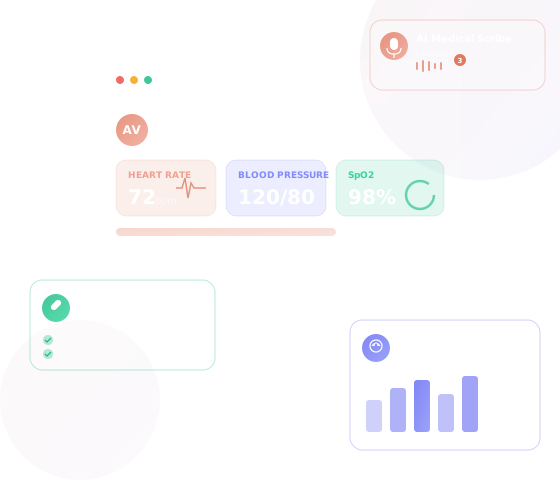
Whether you run a single specialty clinic, a multi-location practice, or a hospital environment, the value of EMR software comes from consistency. Standardized intake, consultation notes, medication history, follow-up planning, and reporting can help teams work with fewer gaps. That is why many organizations looking for EMR software in Usa prioritize systems that are configurable enough for local operations but structured enough to support long-term record quality.
Department workflow
Even without a department-specific use case, most care settings follow a recognizable workflow. A patient is registered, demographic and clinical history are captured, the provider documents the encounter, orders or care instructions are recorded, and the visit ends with discharge, billing handoff, or follow-up scheduling. In inpatient settings, the process extends into admission notes, progress updates, medication tracking, discharge summaries, and continuity planning.
An effective EMR supports this sequence without forcing teams into disconnected tools. Front-desk staff need fast registration and search. Clinicians need structured charting that does not slow down consultations. Nursing and support teams need visibility into care plans and updates. Administrators need reporting that reflects actual activity rather than manually compiled spreadsheets. For buyers comparing EMR software in Usa, workflow fit is often the deciding factor because adoption depends on how naturally the system maps to daily routines.
Features mapped to workflow
Structured patient records: Centralized records help teams access demographics, visit history, diagnoses, medications, allergies, and clinical notes in one place. This supports continuity across repeat visits and reduces dependence on scattered files.
OPD and IPD workflow support: Outpatient and inpatient operations often require different documentation depth and handoff patterns. The platform supports workflows aligned with both, helping teams manage consultations, admissions, progress notes, and discharge documentation more consistently.
AI-assisted notes: Clinicians often need to document quickly while preserving clarity. AI-assisted note support can help draft or organize documentation, which teams can review and finalize according to their own standards.
Template-based charting: Configurable templates make it easier to standardize common encounter types, reduce repetitive typing, and improve completeness across providers.
Multilingual documentation: In diverse care environments, multilingual support can help teams document and communicate more effectively where operationally relevant.
Role-based access: Different users need different levels of visibility. Role-based controls support workflows aligned with privacy and operational responsibilities, especially where registration, clinical, and administrative tasks intersect.
Reporting and operational visibility: Clean data capture improves reporting for visit trends, documentation completeness, and workflow monitoring. This is useful for clinics and hospitals that want better oversight without adding manual work.
How It Works
The rollout approach for this EMR is designed as a phased implementation so teams can move from setup to adoption in a controlled way.
- Configure intake and registration workflows: Start by setting up patient registration fields, visit types, provider lists, and front-desk workflows. This creates a consistent intake process for new and returning patients and helps standardize demographic capture, identifiers, and appointment-linked records.
- Build documentation templates for consultations and admissions: Next, configure structured templates for OPD consultations, inpatient notes, history capture, medication lists, and discharge or follow-up summaries. This step helps clinicians chart in a more uniform format while preserving flexibility for specialty-specific details.
- Enable role-based access for care teams: Assign access by role so reception, clinicians, nursing staff, and administrators see the functions relevant to their work. This supports policy-aware record controls and helps reduce unnecessary exposure of sensitive information while keeping workflows efficient.
- Train teams on live charting and follow-up workflows: During adoption, staff use the system for registration, consultation documentation, chart updates, care instructions, and follow-up planning. AI-assisted notes and multilingual documentation can be introduced where they fit operational needs, with providers reviewing all final entries.
- Review records, reporting, and optimization opportunities: After go-live, teams audit documentation quality, template usage, reporting outputs, and handoff consistency. Administrators can refine templates, improve workflow steps, and align record practices with organizational expectations over time.
This practical sequence is especially useful for organizations adopting EMR software in Usa across multiple users or locations, where consistency matters as much as feature depth.
Local context
Healthcare organizations in the United States often evaluate EMR systems with close attention to privacy, documentation quality, interoperability expectations, and operational scalability. While every organization has its own policies and legal review process, many buyers want software that supports workflows aligned with common privacy and security expectations in the US healthcare environment. In that context, references to HIPAA often shape how teams think about access controls, record handling, and audit-minded processes.
For clinics and hospitals comparing EMR software in Usa, local context also includes practical realities such as multi-provider coordination, variable documentation styles, and the need to move away from paper-heavy or fragmented digital systems. A useful EMR should not just digitize notes; it should make records easier to maintain, retrieve, and use during care delivery.
Use cases
Single-location clinics: Standardize registration, consultation notes, prescriptions, and follow-up records in one system.
Multi-doctor practices: Create more consistent charting across providers while preserving role-based access and shared visibility where appropriate.
Hospitals: Support OPD and IPD workflows with structured records, admission-related documentation, progress notes, and discharge summaries.
Growing healthcare groups: Use implementation playbooks and stable workflow design to support phased adoption across teams and locations.
Documentation improvement initiatives: Replace free-form or inconsistent note-taking with templates, structured fields, and reviewable records.
These scenarios reflect why organizations searching for EMR software in Usa often look for a balance between usability, structure, and operational control rather than a one-size-fits-all system.
FAQ
What types of healthcare organizations can use this EMR?
It is suitable for clinics, multi-provider practices, and hospitals that need structured patient records, consultation documentation, and workflow support across outpatient or inpatient operations.
Does the software support both clinical and administrative workflows?
Yes. It is designed to support registration, charting, follow-up documentation, and reporting, helping clinical and administrative teams work from a more consistent record system.
Can teams customize templates?
Yes. Documentation templates can be configured to reflect common encounter types, helping organizations standardize records while adapting to their own operational needs.
How does access control work?
The platform supports role-based access so users can be given permissions aligned with their responsibilities. This helps organizations manage visibility in a more controlled way without claiming universal legal compliance.
Is this relevant for US healthcare organizations?
Yes. The product is relevant for organizations evaluating EMR software Usa healthcare needs, especially where structured records, privacy-aware workflows, and scalable implementation matter.
CTA
If you are evaluating EMR software in Usa, focus on how the system will perform during real registration, consultation, charting, discharge, and reporting workflows. A practical EMR should help your team document more consistently, improve record visibility, and support phased adoption without unnecessary complexity. Explore the platform to see how structured records, workflow-based templates, and implementation playbooks can support your clinic or hospital operations.